Roofers in York
In York, the roof often tells you how old the house is: clay pantiles on the oldest buildings, Welsh slate on the Victorian terraces, hipped roofs on the estates built between the wars. With 35 conservation areas and over 2,000 listed buildings, matching what's there matters. I cover York from my base in Leeds.
I reply to every enquiry within 1 hour, 7am–7pm.
Pantiles, slate and the age of the house
Most of York is brick. It has been the standard walling material since the late 17th century, and dozens of medieval timber-framed houses survive in the city centre, often hidden behind later fronts.
The roofs changed with the centuries. The Royal Commission's survey of the city found that clay pantiles were the most common covering on houses built before the 18th century, that the better Georgian houses had Westmorland slate, and that Welsh slate became the normal roof in the 19th century, once the railways could bring it in. The council's appraisal of the city centre asks for the "choppy sea" of pantile roofs in key views to be conserved. Many houses in the centre still have lead rainwater heads, most dating from a Corporation order in 1763.
Victorian terraces
From the city walls you can look down on Bishophill's late-Victorian terraces, with what the council calls a "regular rhythm of slate roofs, chimneys and dormer windows". South Bank, Clementhorpe, Leeman Road, the Groves and Clifton have streets of brick terraces from the late 19th and early 20th centuries, built with pitched roofs and chimneys. On Salisbury Road, off Leeman Road, there's something rarer: a group of 1930s flat-roofed Art Deco houses believed to be unique in York.
Very little was built in York in the Edwardian years. House-building slumped after 1901, and homes from 1900 to 1918 make up only about 2% of the city's houses today.
Garden village and council estates
The big exception is New Earswick, the garden village begun in 1904 and extended up to 1954: local red brick, whitewashed in places, with steep gables and French tile roofs. Most of the original houses are Grade II listed, and the 1970s modernisation of the village included removing chimney stacks.
Between the wars, the council built Tang Hall, with 1,272 houses finished by the end of 1928. They have hipped roofs, and each was built with a flat porch roof, most of which survive. The council estates of the 1930s to 1950s in Acomb, including Chapelfields and around Foxwood Lane, generally have hipped roofs with chimneys. About one in six York homes was built between the wars, and nearly one in five between 1945 and 1964.
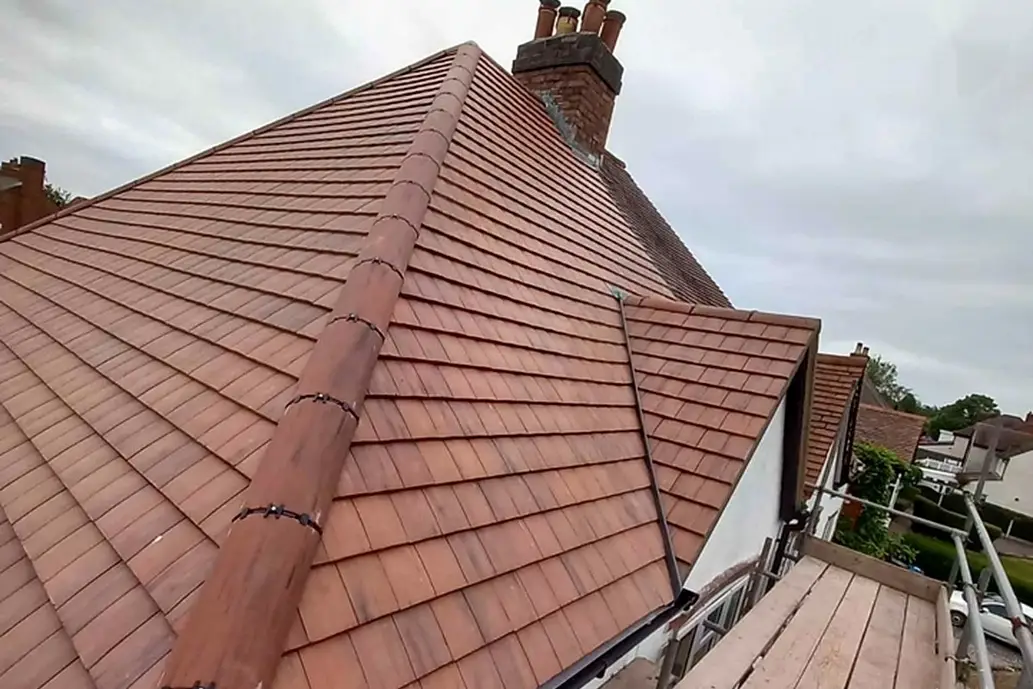
What goes wrong with York roofs
- Matching old roofs. A repair to a pantile or old slate roof has to match what's there in colour, shape and size, which usually means reusing the roof's own tiles or slates and finding a close match for the rest.
- Tired Welsh slate. On a 19th-century terrace, the slate often outlasts the nails holding it, and slates start to slip.
- Hips as well as ridges. Hipped roofs on the 1920s to 1950s estates have more ridge and hip tiles to keep fixed, and old mortar bedding gives way.
- Small flat roofs. Porch roofs on estates like Tang Hall, and flat-roofed houses like those on Salisbury Road, need re-covering from time to time like any flat roof.
- Frost. York is drier and calmer than England on average, but it gets more frosty days, and frost is hard on old mortar in ridges and chimney stacks.
The services that matter most here
For the houses York has, these are the three most likely to matter:
- Roof repairs: slipped and broken tiles and slates replaced with matching ones, and leaks traced to their source.
- Slate roofing: repairs and re-roofs for the city's Victorian Welsh slate.
- Ridge tile repointing: re-bedding or dry fixing the ridges and hips on inter-war and post-war roofs.
For porch roofs and other small flat roofs, see flat roofing.
Listed buildings, conservation areas and Article 4
York has 35 conservation areas and, by the council's count, over 2,000 individual listed buildings. On a listed building, any change that affects its character needs listed building consent. Replacing a few slipped tiles or slates with matching ones normally doesn't.
Two of York's Article 4 directions cover roofs. At East Mount Road, they cover roof slopes facing the road and chimneys, though an exact like-for-like replacement is exempt. In Heslington, they cover roofing materials, rooflights, solar panels and chimney stacks on elevations the public can see. If you're unsure what applies to your house, check with City of York Council before any work is booked.
Covering York from Leeds
York is about 25 miles from Leeds along the A64. I cover it the same way as anywhere else. I reply to every enquiry within 1 hour, 7am–7pm. I come out, look at the roof properly and explain what I've found, and you get a free written quote with the price fixed before any work starts.
City-centre jobs take a little more planning. The footstreets are closed to vehicles from 10.30am to 5pm every day, and scaffolding on the highway needs a licence from the council, applied for at least five working days ahead.
See all the areas I cover, including the towns between York and Leeds.
York roofing questions
Can I replace the slate on my terrace with concrete tiles?
Usually without planning permission, unless the house is listed or covered by an Article 4 direction, like those at East Mount Road and in Heslington. In a conservation area, check with the council first. But Welsh slate is the original roof on most 19th-century York houses, and concrete tiles are heavier, so the roof timbers would need checking. I'll talk you through it honestly.
Do I need permission to remove a chimney in York?
It depends where you are. At East Mount Road and in Heslington, Article 4 directions bring chimneys under planning control, so altering or removing one there needs planning permission. On a listed building, it needs listed building consent. Elsewhere in a conservation area, check with the council before any work is booked.
My New Earswick house has French tiles. Can they be replaced?
Most of the original New Earswick houses are Grade II listed, so changing the roof covering would need listed building consent. Replacing a few broken tiles with matching ones normally doesn't. For anything bigger, talk to City of York Council's conservation team first.
The flat porch roof on my Tang Hall house leaks. Repair or replace?
It depends on the covering and the deck underneath. A small split can sometimes be repaired, but if the covering has failed across the porch or the boards have gone soft, re-covering it is the lasting fix. I'll look at it and tell you which.
Free written quote, fixed price agreed before any work starts.
Tell me what's going on with your roof. I'll come out, look at it properly and put the price in writing.
I reply to every enquiry within 1 hour, 7am–7pm.