Roofers in Harrogate
Central Harrogate went up mostly between 1850 and 1920, in local gritstone under Welsh slate, and much of it sits in the Harrogate Conservation Area. On these roofs, matching what's there, from the slate to the ridge tiles and finials, is most of the job. I cover Harrogate from my base in Leeds.
I reply to every enquiry within 1 hour, 7am–7pm.
A Victorian and Edwardian spa town
Little of Harrogate is older than about 1850. The council's appraisal dates most of the town centre to between 1850 and 1900, and the years from 1900 to 1920 added most of the Duchy, the Dragon estate and much of the area south of the Stray. Earlier in the 19th century, terraces such as those at West Park were built in a Georgian style, and villas followed from the middle of the century.
The centre is mostly three storeys, often with basements and attics. Around Franklin Road and Kings Road, tall middle-class terraces stand beside two-storey artisans' terraces, and many of the big houses are now flats or guest houses. The Duchy, built mostly between 1900 and 1920 on Duchy of Lancaster land, is a district of villas, many of them semi-detached.
Further out, Starbeck grew up as railway workers' terraces after its station opened in 1848–49, and Pannal's old gritstone core was joined by brick semis from about 1930. Not everything is Victorian: away from the centre, areas such as Bilton were largely built after the war.
Gritstone, Welsh slate and clay tiles
The walls are local sandstone, known as gritstone, quarried at Harlow Hill, Hookstone and Knox. Brick and render become more common after 1900, and Starbeck is mainly brick.
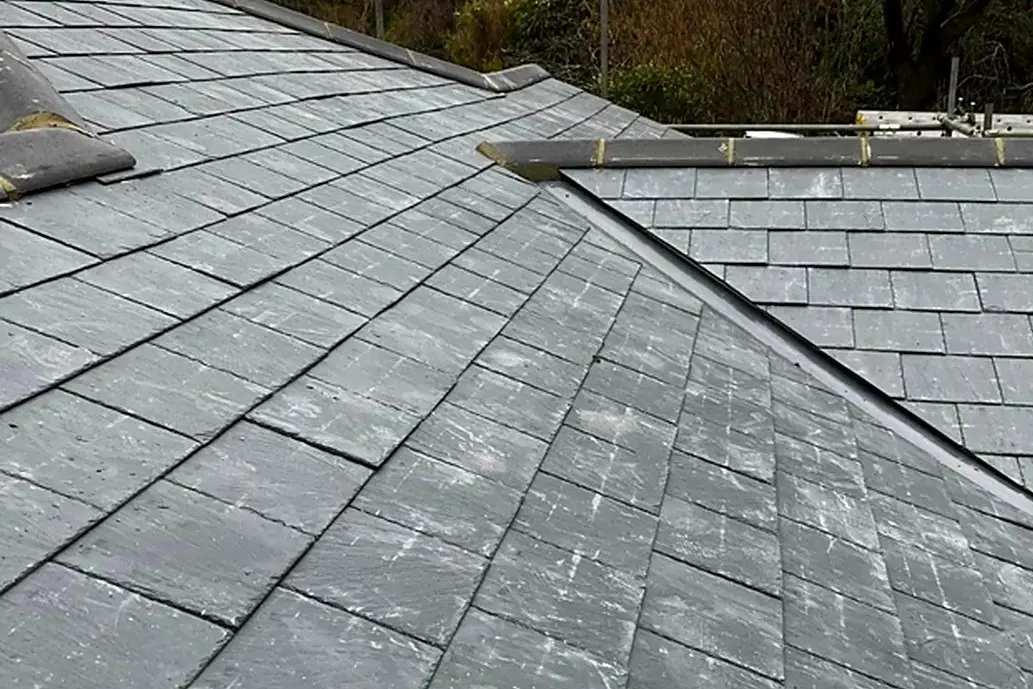
Welsh slate dominates the roofs: a heather-coloured slate, often finished with clay ridge tiles. Some older roofs are stone slate or green Westmorland slate. On Edwardian houses, clay plain tiles rival slate, and the later Duchy houses have clay tiles and tile-hung walls.
The details are what make these roofs. The Duchy villas have decorated bargeboards, ridge tiles and finials, dormers, tall stone chimney stacks and small roofs over their bays and doors. North of the centre, many houses have timber gutters on brackets and canopies over the doors and bays, and the Cold Bath Road terraces have lean-to roofs over their bay windows.
What goes wrong with Harrogate roofs
- Slipping slate. Welsh slate lasts a long time, but the nails holding it don't. A few slipped slates is a repair. Once they're slipping across the roof, it's time for new fixings.
- Junctions. Bays, canopies, dormers, valleys and lean-to roofs all mean places where one roof meets another or meets a wall, and every one of those needs sound lead or flashing.
- Tall stacks. Stone chimney stacks need repointing over time, and the council's guidance asks for lime mortar rather than cement on historic buildings.
- Decorative ridges. Ornamental ridge tiles and finials work loose as the mortar under them fails, and the council's guidance asks for them to be kept.
- Changing a stone slate roof. Stone slate is much heavier than Welsh slate, so any change of covering affects the roof timbers as well as the look.
The services that matter most here
For the houses Harrogate has, these are the three most likely to matter:
- Slate roofing: refixing slipped slates, valleys and slate re-roofs matched to the coursing and colour of the old roof.
- Chimney repairs: repointing tall stone stacks, flaunching and new leadwork.
- Ridge tile repointing: re-bedding ridge tiles and finials so they stay put and keep their character.
The Harrogate Conservation Area
The Harrogate Conservation Area, designated in 1973, takes in the town centre and much of the Victorian and Edwardian housing around it, including the Duchy, High Harrogate and the streets off Leeds Road. Starbeck Spa and Pannal have conservation areas of their own. Since April 2023, planning in Harrogate has been handled by North Yorkshire Council.
The council's heritage guidance for the area is specific about roofs. It expects like-for-like materials, keeping slate coursing, ridge and cresting tiles, finials, chimney stacks and pots, and lime mortar rather than cement. It favours timber or cast-iron gutters with cast-iron downpipes, though aluminium may be acceptable on unlisted buildings. The appraisal adds that big changes to rooflines, poor materials, and intrusive dormers or roof windows aren't acceptable.
If you're planning a change to your roof, check with North Yorkshire Council's planning team first.
Covering Harrogate from Leeds
Harrogate is about 15 miles north of Leeds, up the A61 through Harewood and Pannal. I cover it the same way as anywhere else. I reply to every enquiry within 1 hour, 7am–7pm. I come out, look at the roof properly and explain what I've found, and you get a free written quote with the price fixed before any work starts.
Many of the town's big houses are three storeys with attics, so scaffolding is often part of the job, and it's included in your written quote when it is. See all the areas I cover.
Harrogate roofing questions
My house is in the Harrogate Conservation Area. Can I re-roof it?
Yes. Re-roofing in matching materials doesn't normally need planning permission. The council's heritage guidance expects like-for-like materials, and asks for a technical reason or historic evidence before a change of roof covering, so swapping Welsh slate for tiles is unlikely to be welcomed. Check with North Yorkshire Council before any work is booked.
Does the quality of the slate matter?
Yes. The council's own heritage guidance shows cheap slate that started to break up within five years. Good natural slate, laid to match the coursing on the rest of the roof, lasts. I'll tell you what I'd use and why when I quote.
Our villa is split into flats. How does a roof repair work?
The roof is usually shared, so the owners, or the freeholder or managing agent, need to agree the work. I'll look at the whole roof and put the quote in writing, so everyone can see what's needed and why.
Can you match the clay tiles and tile hanging on our 1920s house?
Usually. Clay plain tiles are still made, and where the colour of an old roof matters, sound tiles from the roof itself are the best match. I'll show you the match before any work starts.
Free written quote, fixed price agreed before any work starts.
Tell me what's going on with your roof. I'll come out, look at it properly and put the price in writing.
I reply to every enquiry within 1 hour, 7am–7pm.